Syllabus
Overview
Course Description:
The goal of this course is to understand the fundamental computation models in computer science. That is, we formalize computation into theoretical models, and for each model, we identify essential resources. With that, we aim to reveal the feasibilities and limitations of models and resources, for all problems. In this course, we frequently ask and sometimes answer two questions:
- Can we replace one resource with a different resouce, potentially in a different model?
- What are the implications of the feasibilities and limitations?
We discuss these questions by defining computation models and their resources, such as the time and space of Turing machines and the sizes of circuits, and then we categorize problems into complexity classes using the models. A main goal is to for us to understand how theoretical computer scientists reason about these questions, and connecting that theory to practical questions about computing. Another main goal is to learn the essential tools and techniques that is applied to solve many challenges.
Course Objectives: Students who complete the course will understand the following:
- Formal models of computation, such as (nondeterministic) Turing machine, alternation, circuits, and formulas.
- Resouces of the models, such as time, space, randomness, communication, and circuit size, and understand the relations between resources.
- Interactive proofs and probabilistic-checkable proofs.
- Derandomization and pseudorandomness.
- Some lower bounds and natural proofs.
Class Meetings: The meetings of the course are scheduled for Mondays and Wednesdays, 2–3:15pm.
Preparation
Prerequisites: To enroll in CS 6160, students must have completed CS 3120 (DMT2 at UVA CS) with a grade of C- or better (or an equivalent course and grade).
Expected Background: We expect students entering CS 6160 to be comfortable reading and writing definitions, theorems, and proofs. From the prerequisite CS 3120, we expect students to understand the Turing machine model and basic complexity classes, such as polynomial time (P), exponential time (EXP), and NP. We will also use basic probability, basic linear algebra, and basic algebra.
Students will be asked to turn in assignments that is typeset in LaTeX.
Course Staff
Instructor: The course is taught by Wei-Kai Lin (wklin-course@virginia.edu). Feel free to contact Wei-Kai with any questions about the course, computer science, or anything else you think I can help with. 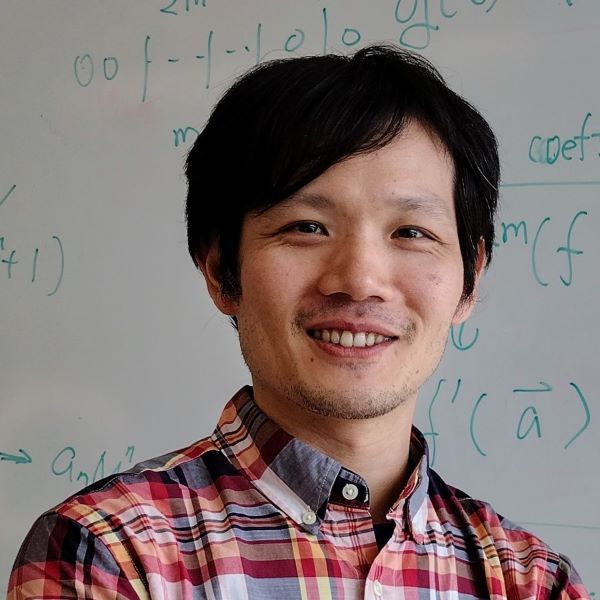
Office Hours: Thursdays, 9am - 10am.
Learning Materials
Textbook: Sanjeev Arora and Boaz Barak, Computational Complexity: A Modern Approach. Draft of the book is available, but some chapter numbers differ.
Additional materials: The book Introduction to Theoretical Computer Science by Boaz Barak is a good review for the prerequisites. For the course materials, complexity is taught in many institutes, and some of them maintained high-quality lecture notes and scribes. Here are some of them.
- Computational Complexity, Harvard, 2024, by Madhu Sudan. Syllabus and All Lecture Notes. We plan to cover many topic in this course.
- Computational Complexity, UW, 2024, by Thomas Rothvoss. Lecture notes.
- Computational Complexity, Princeton, 2009, by Boaz Barak. Website. The website gives lecture notes, HW problems, and links to many materials.
For derandomization, pseudorandomness, expanders, and extractors, the book Pseudorandomness by Salil Vadhan is the standard reference.
Communication
We will primarily use the course website for posting course materials and use UVA Canvas for interactive communications.
Course Website: We will post all course materials at https://weikailin.github.io/cs6160-complexity.
In general, if you have any questions that will be relevant to other students, please ask them on Canvas publicly. This will get the fastest response, since all of the course staff and students will see your question there and be able to respond to it.
Email: You should use the course Canvas for questions about the course content that are relevant to all students. If you have personal questions or things to discuss with Wei-Kai, please do this by emailing (wklin-course@virginia.edu).
Coursework
Presenting and scribing
This course aims to be interactive and requires significant class participation, particularly, reading, presenting, and discussing. For each meeting, a student presenter starts the lecture with a brief high-level overview, or a recap in some cases; the presenter shall also actively ask or answer during the meeting. After each meeting, a scriber shall polish and then publish his/her scribed notes. See the details below.
The student presenter shall do the following:
- 1 week before the lecture: Discuss the materials of the lecture, such as book sections, lecture notes, or papers.
- 2 days before the lecture: Finish reading materials, and post the outline or the summary of the lecture.
- First 10 minutes of the lecture: Talk about the topics at a high level, birefly; aim for 10 minutes presentation and roughly 1 minute for quick questions. If well-prepared and agreed in advance, the presenter can take more time.
- The remaining lecture: The instructor will talk about the topics in detail, but the student presenter shall participate in asking or answering questions.
The scriber shall do the following:
- Attend the lecture, and ask or answer questions.
- In a week after the lecture, typeset and turn in scribed notes.
- All scribed notes will be publicly posted on the course website.
Written assignments
There will be optional written assignments. Similar to many other mathematical or theoretical courses, most learning in this course is done by solving problems on your own and in collaboration with others. So, written assignments were often heavy in many complexity courses (we see that in the above courses). However, putting grades on written assignments may just incentivize copying AI solutions. Hence, we offer problem sets and due dates, and you will get feedback later if you turn in your solutions; there is no grades.
Quizzes
We have two quizzes, each is short, likely 20 minutes. The purpose of quizzes is to assess students’ progresses, so that the lectures can be fine-tuned. We will discuss and finalize the date and time after the semester started.
Grading
We encourage students to spend your energy focusing on what you are learning, instead of worrying about your grade.
That said, we understand students are often stressed about grading and understandably want to know how grades will be determined. We aim to grade in a way that is useful (provides students with accurate measure of how well they understood what they should), motivating (encourages the behaviors we prefer, including hard but not obsessive work), fair (assigned higher grades to more deserving students), robust (arbitrary small perturbations do not have a material impact on someone’s grade), and low stress (for both students and the course staff).
For this reason, we choose not to prescribe a singular mathematical formula for quantitatively assigning letter grades but do provide a formula that can be used to compute a lower bound on the grade you receive in the course:
| Item | Standard Weighting |
|---|---|
| Presenting the lecture overview (9% for participation) | 54% |
| Scribing lecture notes (6% for participation) | 36% |
| Quizes | 10% |
With the exception of cases of academic dishonesty or inappropriate behavior, we guarantee that you will a grade that is not below the grade that would result from computing your score using the percentages in the table, where your score for each item is the ratio of the score you received to the target score for that item, and the grading scale is based on the standard decades (e.g., 0.87 = B+, 0.9 = A-, 0.93 = A).
This is a minimum grade, though, and we generally want to assign a grade that reflects the best possible interpretation of all you have done during the semester. This means we consider your performance throughout the course, and will examine grades using a variety of different methods that weights different aspects differently and rewards performance improvements, but also allows consistent performance to make up for one slip-up.
An “A” grade means we are convinced that you can use the material in this class to solve new problems and understand it well enough to explain most concepts in the class. A “B” grade means we are convinced that you understand the main ideas in this class well enough to be well prepared for a follow-on course (i.e., one that has this as a pre-requisite). See the CS Department Grading Guidelines.
Although the material we cover is challenging, and the pace may seem overwhelming at times, we are confident that all students who put effort into this class and take good advantage of available help will do well.
Bonus Points. We hope students will go beyond the provided assignments and do other things to contribute to the class as well as beyond. Hence, we give bonus points occasionally. That includes (but not limited to) solving challenge problems in problem sets, reporting bugs in the course materials, and participating in class. We will clearly make the bonus points in problems, but in some cases, it is up to the instructor’s discretion. In general, the staff reserve the right to “bump up” the grades.
Honor Expectations
We believe strongly in the value of a community of trust, and expect all of the students in this class to contribute to strengthening and enhancing that community.
The course will be better for everyone if everyone can assume everyone else is trustworthy. The course staff starts with the assumption that all students at the university deserve to be trusted.
Collaboration Policy: We believe it is important for students to learn by thinking about problems on their own, so it is expected that each student studies the provided materials and attempts to solve the problems on their own. After that, you are welcome to also discuss problems on the problem sets with students and others, including search engines and AI/LLM tools, such as ChatGPT. Whenever collaboration or references is used, it is required to cite, quote, and state the source precisely and clearly to academic standards.
We aim to make the language describing the policy as clear and unambiguous as possible, but if anything is ever unclear about the stated policy for an assignment, please clarify with the course staff. The penalty for policy violations will be considered on a case-by-case basis, with a penalty commensurate the severity of the offense.
Additional Information
Special Circumstances: The University of Virginia strives to provide accessibility to all students. If you require an accommodation to fully access this course, please contact the Student Disability Access Center (SDAC) at (434) 243-5180 or sdac@virginia.edu. If you are unsure if you require an accommodation, or to learn more about their services, you may contact the SDAC at the number above or by visiting their website https://studenthealth.virginia.edu/sdac
Accommodations: It is the University’s long-standing policy and practice to reasonably accommodate students so that they do not experience an adverse academic consequence when serious personal issues conflict with academic requirements. Although University policy only recognizes religious accomodations, the course instructors believe they are many other valid reasons for accomdations that are at least as justifiable as ones for religious observance and consider family obligations, personal crises, and extraordinary opportunities to all be potentially valid reasons for accomodations. Students who wish to request accommodations should submit their request to the instructor as far in advance as possible.
If you have questions or concerns about the University policy on academic accommodations for religious observance or religious beliefs, visit https://eocr.virginia.edu/accommodations-religious-observance or contact the University’s Office for Equal Opportunity and Civil Rights (EOCR) at UVAEOCR@virginia.edu or 434-924-3200.
Safe Environment: The University of Virginia is dedicated to providing a safe and equitable learning environment for all students. To that end, it is vital that you know two values that we and the University hold as critically important:
- Power-based personal violence will not be tolerated.
- Everyone has a responsibility to do their part to maintain a safe community on grounds (including in virtual environments).
If you or someone you know has been affected by power-based personal violence, more information can be found on the UVA Sexual Violence website that describes reporting options and resources available: https://www.virginia.edu/sexualviolence.
As your professors and as humans, know that we each care about you and your well-being and stand ready to provide support and resources as we can. As faculty members, we are responsible employees, which means that we are required by University policy and federal law to report what you tell us to the University’s Title IX Coordinator. The Title IX Coordinator’s job is to ensure that the reporting student receives the resources and support that they need, while also reviewing the information presented to determine whether further action is necessary to ensure survivor safety and the safety of the University community. If you would rather keep this information confidential, there are Confidential Employees you can talk to on Grounds (see https://eocr.virginia.edu/chart-confidential-resources). The worst possible situation would be for you or your friend to remain silent when there are so many here willing and able to help.
Well-being: If you are feeling overwhelmed, stressed, or isolated, there are many individuals here who are ready and wanting to help. The Student Health Center offers Counseling and Psychological Services (CAPS) for all UVA students. Call 434-243-5150 (or 434-972-7004 for after hours and weekend crisis assistance) to get started and schedule an appointment. If you prefer to speak anonymously and confidentially over the phone, Madison House provides a HELP Line at any hour of any day: 434-295-8255.